
Relocating to Loves Park, IL: Essential Tips for a Smooth Move in 2026
Loves Park, Illinois blends small-city convenience with direct access to Rockford and regional employers, drawing many relocations each year. According to U.S. Census QuickFacts, the city counted about 23,397 residents in 2020, with steady growth since the early 2000s. That scale supports local amenities without overwhelming traffic. Understanding neighborhoods near Riverside Boulevard, North Second Street, and Perryville Road, along with schools, parks, and commuting options, helps new arrivals structure a smoother move into Loves Park during 2026’s shifting housing market.
What key neighborhoods in Loves Park, IL suit different lifestyles?
Neighborhood choices in Loves Park span riverfront sections near the Rock River to family-focused streets around Harlem Road and Alpine Road. Areas near Riverside Boulevard offer quick access to shopping centers, medical offices, and restaurants such as Backyard Grill & Bar and Lino’s in nearby Rockford. According to Walk Score, some central corridors reach walk scores in the mid-50s, while car-dependent pockets sit lower, guiding decisions about proximity to errands.
Established subdivisions near Harlem High School and Harlem Middle School feature tree-lined streets, moderate lot sizes, and a mix of ranch and two-story homes. Many houses were built between the 1960s and 1990s, with updated kitchens, finished basements, and garages common. Closer to Rock Cut State Park, newer developments near Perryville Road and Rock Cut Elementary School provide easier access to outdoor recreation and modern floor plans. Condo and townhome options sit along major routes like North Second Street for residents prioritizing low-maintenance living.
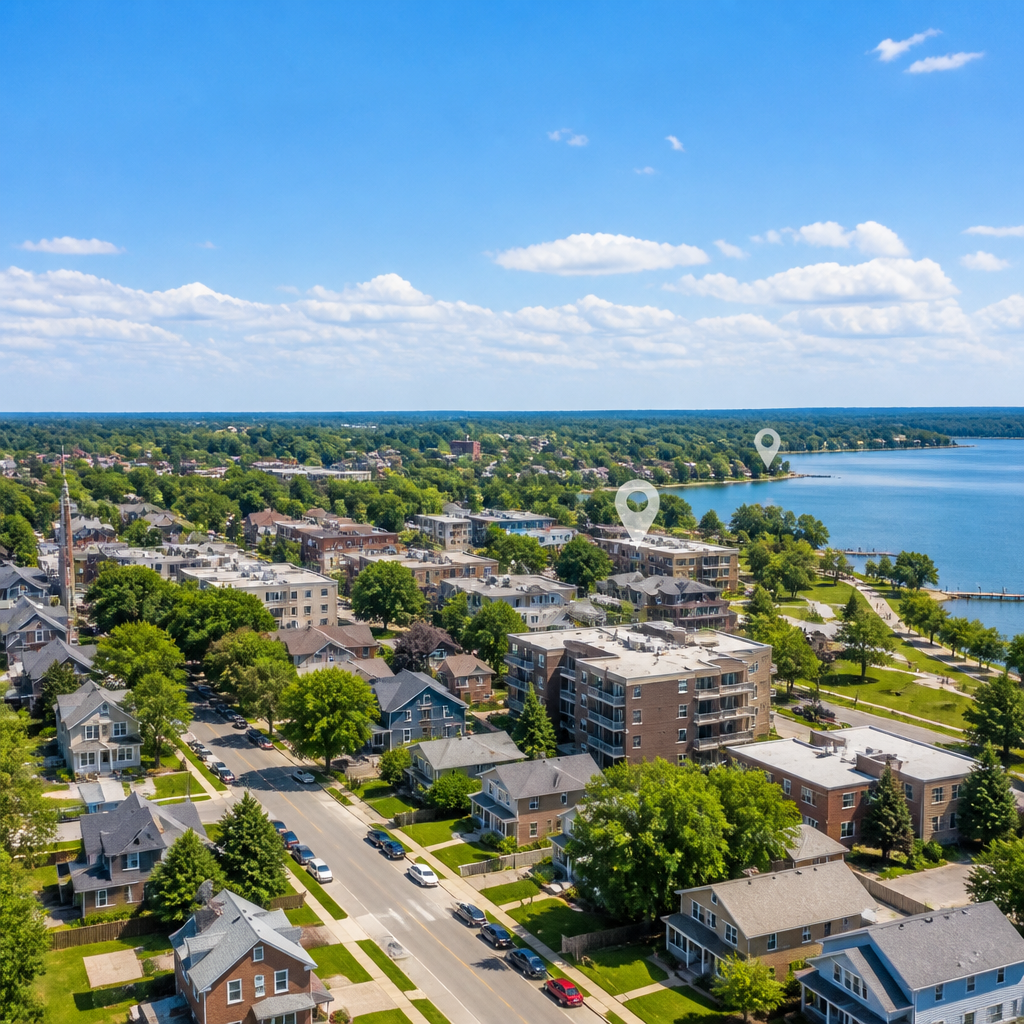
On a clear summer evening along East Riverside Boulevard, headlights glint off the Rock River as families stroll the riverside path near Martin Park, the air carrying the faint scent of grilled burgers from nearby patios. The low hum of traffic mixes with laughter from the playground while soft light spills from storefronts near North Second Street. That combination of movement and relaxed atmosphere often becomes a first sensory introduction to Loves Park for new residents driving in from Interstate 90.
Water-oriented sections close to Rock River Lane and River Lane Road appeal to residents who prioritize fishing, boating, or scenic views. Properties near the river can command premiums of several tens of thousands of dollars compared with similar homes inland, based on listing ranges tracked by Redfin through early 2026. Entry-level homes in less central neighborhoods often appear in the $160,000 to $230,000 range, while renovated properties near key corridors can extend beyond $300,000, depending on size and finish level.
How does the Loves Park housing market look heading into 2026?
Market conditions in Loves Park heading into 2026 show moderately competitive dynamics rather than extreme bidding wars. According to housing data summarized by Redfin, typical sale-to-list ratios in the broader Rockford region often hover near 100%, with some properties selling slightly above asking in busier months. Entry-level buyers target homes between roughly $170,000 and $250,000, while move-up shoppers more often close transactions in the $260,000 to $340,000 bracket, depending on neighborhood and size.
Winnebago County’s property tax environment remains a crucial factor for relocation budgets. Based on estimates from SmartAsset, effective property tax rates in the county often fall in a range around 2.4% to 2.9% of assessed value. For a home purchased at approximately $230,000, that can translate into annual property taxes in the vicinity of $5,500 to $6,500, depending on exemptions and specific assessment details.
Financing choices remain relatively flexible for incoming residents. FHA loans commonly permit minimum down payments of 3.5%, while conventional loans frequently start around 3% to 5%, assuming qualifying credit. On a purchase near $250,000, that can place down payment requirements roughly between $7,500 and $12,500. Many relocating households also allocate an additional $3,000 to $6,000 for closing costs, inspections, and immediate improvements such as paint, flooring, or minor repairs in Loves Park properties.
Rental options provide a bridge for households evaluating neighborhoods before buying. According to listings trends in early 2026 tracked by Redfin, many two-bedroom apartments in the Loves Park and north Rockford corridor advertise monthly rents between about $950 and $1,300. Single-family rentals near Harlem Road and Alpine Road often start closer to $1,400 and extend above $1,800 for larger floor plans or recently renovated homes, especially those within walking distance of schools or major parks.
What schools and family resources shape daily life in Loves Park?
Loves Park falls primarily within the Harlem School District, which anchors family decision-making throughout the area. Harlem High School in nearby Machesney Park, Harlem Middle School, and schools such as Rock Cut Elementary, Marquette Elementary, and Maple Elementary serve many local neighborhoods. According to GreatSchools, Harlem High School currently receives a rating around the mid-range of the 10-point scale, with particularly strong extracurricular and athletics programs that draw students from across the district.
Elementary campuses like Forest Hills Elementary School and Loves Park Elementary provide playgrounds, community activities, and after-school events that tether households to their immediate blocks. The Harlem Community Center along Harlem Road hosts youth sports, fitness classes, and seasonal programs. For those pursuing higher education, Rock Valley College on East State Street and Rockford University to the south expand options within a roughly 10 to 20-minute drive, depending on traffic and starting point in Loves Park.
On crisp autumn mornings outside Rock Cut Elementary School, the crunch of leaves underfoot mixes with the sharp scent of fresh coffee drifting from a nearby Casey’s on Perryville Road. The rising chatter of students waiting along Rock Cut Drive blends with the shrill call of geese overhead, migrating across the pale sky above Rock Cut State Park. That combination of familiar school sounds and wide-open natural scenery gives daily routines in Loves Park a distinctly grounded feel.
Families balancing activities across multiple age levels often rely on Mercyhealth Sportscore Two along Elmwood Road for tournaments and practices. That complex offers soccer fields, indoor sports facilities, and connections to regional leagues throughout northern Illinois and southern Wisconsin. Parks such as Martin Park, Wantz Park, and the nearby Rockford Park District facilities around Sinnissippi Park add layers of recreation within a 5 to 20-minute radius. Those overlapping options support both structured athletics and informal weekend outings across the Loves Park area.
How do commuting, transportation, and daily logistics work in Loves Park?
Commuting patterns into and out of Loves Park vary by employer location but typically remain manageable. According to travel-time estimates compiled from U.S. Census data, average one-way commute times for local residents often fall around 20 to 25 minutes. Major corridors such as North Second Street (Illinois 251), Riverside Boulevard, and Perryville Road connect quickly to Rockford employment centers, including the SwedishAmerican Hospital campus and industrial facilities along East Riverside and Forest Hills Road.
Interstate access represents a major advantage for residents who travel frequently. Interstate 39/90 sits only a short drive east via Riverside Boulevard or East State Street, shortening trips toward Madison, Janesville, and Milwaukee to the north and Chicago to the southeast. From central Loves Park, downtown Chicago lies roughly 90 miles away, translating into about 1.5 to 2 hours by car in typical traffic. Chicago Rockford International Airport, located about 12 to 15 miles south, supports domestic and some international flights.
Public transit service in the broader Rockford metropolitan area centers on fixed bus routes. Rockford Mass Transit District (RMTD) routes extend into parts of Loves Park and Machesney Park, though many residents still rely primarily on personal vehicles. According to route maps maintained by local agencies and summarized on Walk Score, transit scores in the region frequently land in the low- to mid-20s, reflecting limited service but viable options along major arterial streets.
Daily errands cluster around retail corridors such as Forest Hills Road and Riverside Boulevard, where grocery stores, pharmacies, and restaurants anchor community activity. A weekly schedule often includes stops at Woodman’s Food Market, Costco on East Riverside, and smaller businesses along Alpine Road. Proximity to these commercial centers can shave 10 to 20 minutes off round-trip errands compared with more rural addresses, influencing where incoming residents target homes or apartments when relocating to Loves Park IL in 2026.
What outdoor recreation and lifestyle amenities define Loves Park living?
Rock Cut State Park forms a signature backdrop for daily life in Loves Park. According to the Illinois Department of Natural Resources’ description of the park on Illinois DNR, Rock Cut spans about 3,092 acres, including more than 40 miles of trails and two lakes, Pierce Lake and Olson Lake. Residents often reach trailheads within a 5- to 15-minute drive, depending on starting point along Perryville Road, Harlem Road, or North Second Street.
Loves Park’s riverfront along the Rock River introduces additional recreation options. Martin Park provides boat launches, picnic shelters, and open spaces for gatherings, while nearby Sinnissippi Park and Nicholas Conservatory & Gardens lie a few miles south on North Second Street in Rockford. The river’s presence influences microclimates and atmosphere throughout the city, with many evenings framed by the glint of sunset on water and the sound of distant motorboats or kayaks skimming past wooded banks.
Golfers frequently gravitate toward courses such as Mauh-Nah-Tee-See Country Club and the public Village Green Golf Course in nearby Rockford, both within about 15 to 20 minutes of most Loves Park neighborhoods. In winter, outdoor activities shift toward cross-country skiing and snowshoeing at Rock Cut State Park or sledding at local hills near Wantz Park. These accessible destinations help residents maintain an active lifestyle across all four seasons without long drives to more distant recreation areas.
Dining and entertainment stretch along Riverside Boulevard, North Second Street, and East State Street. Local establishments like Backyard Grill & Bar, Prairie Street Brewhouse in downtown Rockford, and various family-owned pizza restaurants dot the corridor. Many households budget between $200 and $400 per month for dining out, while allocating another $50 to $150 for movie nights, bowling at Don Carter Lanes, or occasional concerts at BMO Center in Rockford, depending on family size and preferences.
The 23,397-resident figure cited at the start of this guide reflects a city large enough to support diverse amenities yet compact enough for relatively short average commute times near 20 to 25 minutes. That population scale from the opening underscores how school access, riverfront parks, and Rock Cut State Park combine to shape an everyday rhythm distinct from larger metropolitan cores. The Rockford Area Association of Realtors market reports provide one of the clearest region-specific views of inventory shifts and pricing corridors affecting Loves Park households. Buyers and renters who register listing alerts through that platform and schedule property tours within 48 hours of new listings going live before the late-spring surge in May typically secure stronger positions in negotiations. Those who delay engagement until after Memorial Day often confront thinner choices, steeper competition, and a higher likelihood of stretching budgets beyond initial targets when relocating to Loves Park IL in 2026.
FROM OUR BLOG


Janesville, WI Real Estate Market Update: What Buyers Need to Know in 2026
Janesville, WI Real Estate Market Update: What Buyers Need to Know in 2026 The Janesville WI real estate market update for 2026 shows a maturing regional hub with steady housing demand and controlled price growth. According to Zillow, typical home values in Janesville fall roughly in the $220,000 to
Military Relocation to Delavan, WI: Your Comprehensive Guide for 2026
Military Relocation to Delavan, WI: Your Comprehensive Guide for 2026 Delavan, Wisconsin offers a small-city setting that frequently appeals to active-duty and veteran households seeking stability between assignments. According to U.S. Census Bureau QuickFacts, the City of Delavan has a population n

Jennifer Moran
Military spouse, Beloit local since 2016, and Realtor with Moran Homes | EXIT Realty HGM. Jennifer helps buyers, sellers, and relocating families on both sides of the Wisconsin and Illinois state line.